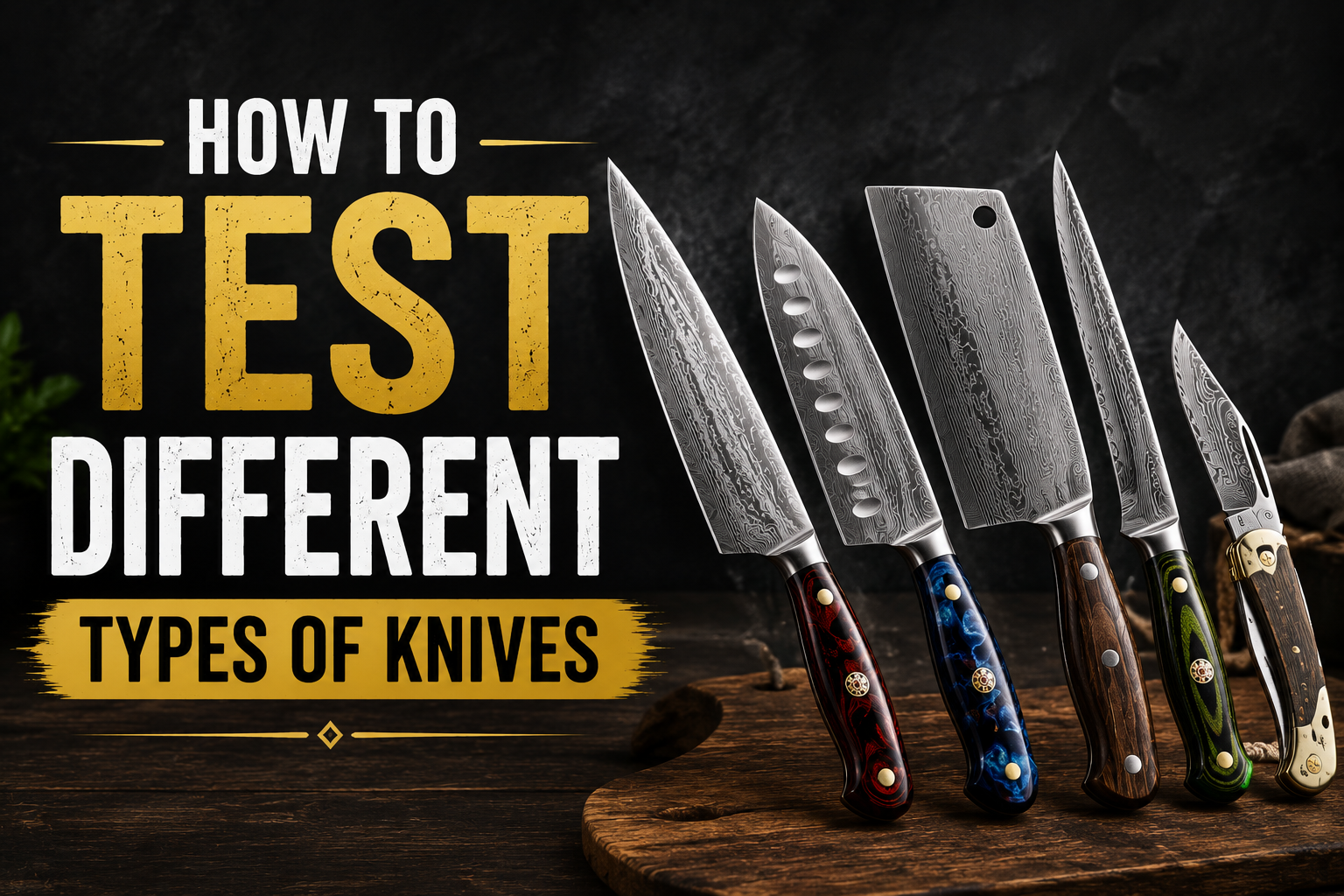
How to Test Different Types of Knives
Whether you’re buying your first kitchen knife, adding a premium Damascus blade to your collection, or simply replacing an old favorite, knowing how to test a knife can help you make a better decision. A knife should feel comfortable, perform efficiently, and maintain its edge over time. The good news is that you don’t need expensive equipment to evaluate most of these qualities.
This guide explains how to test different types of knives, what to look for before purchasing, and how to assess quality safely and effectively.
Why Knife Testing Matters
A knife may look attractive, but appearance alone doesn’t guarantee performance. Testing helps you determine whether a knife is:
Comfortable to hold
Well-balanced
Sharp from the factory
Built with quality materials
Suitable for its intended purpose
Likely to maintain performance over time
Understanding these factors can help you choose a knife that matches your needs and offers long-term value.
Safety First
Before testing any knife:
Handle the blade carefully.
Keep fingers away from the cutting edge.
Test on appropriate cutting materials.
Never attempt unsafe demonstrations, such as catching or throwing a knife.
Store the knife safely after testing.
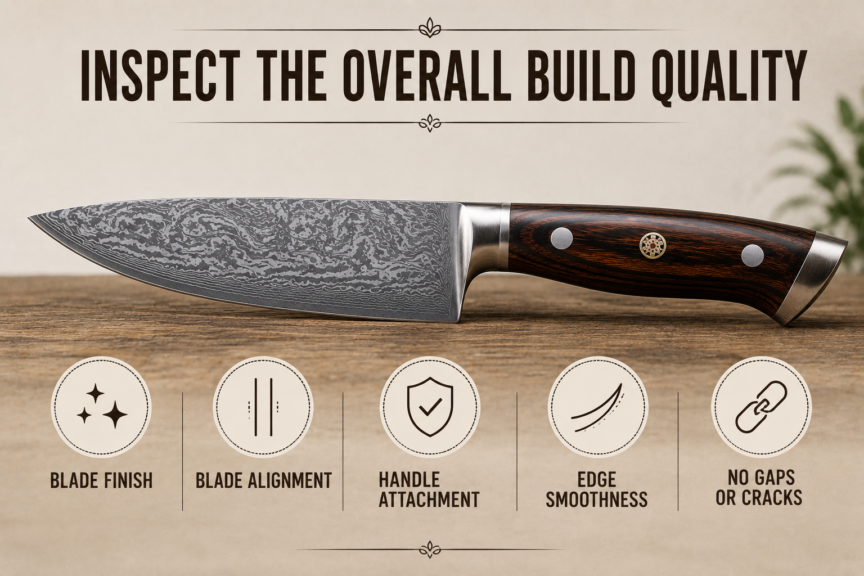
Step 1: Inspect the Overall Build Quality
Start with a visual inspection.
Check for:
Even blade finish
Straight blade alignment
Secure handle attachment
Smooth handle edges
Consistent grind on both sides
No visible gaps between blade and handle
Quality craftsmanship often reflects better manufacturing standards.
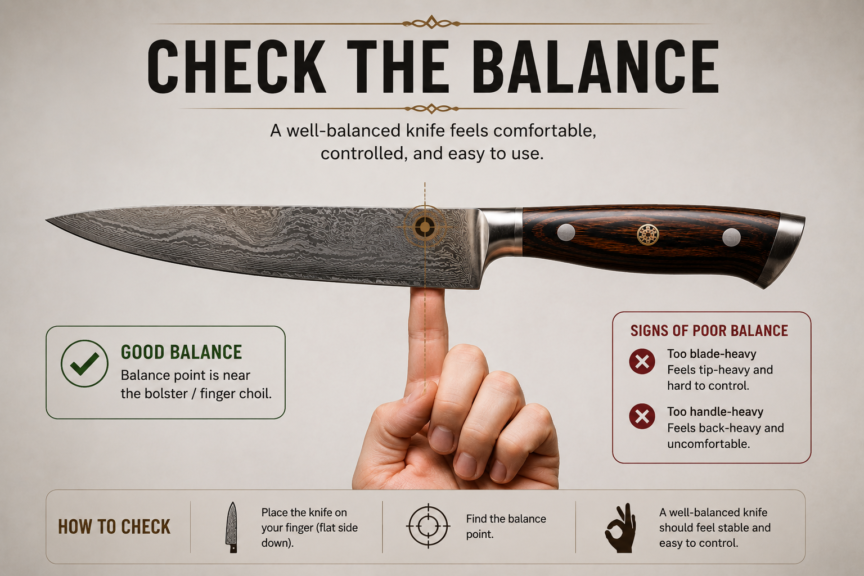
Step 2: Check the Balance
Balance affects comfort and control.
Hold the knife in a natural grip.
Ask yourself:
Does it feel front-heavy?
Does it feel handle-heavy?
Is the weight evenly distributed?
Can you control the blade comfortably?
For many kitchen knives, balance near the bolster or pinch grip area provides excellent control.
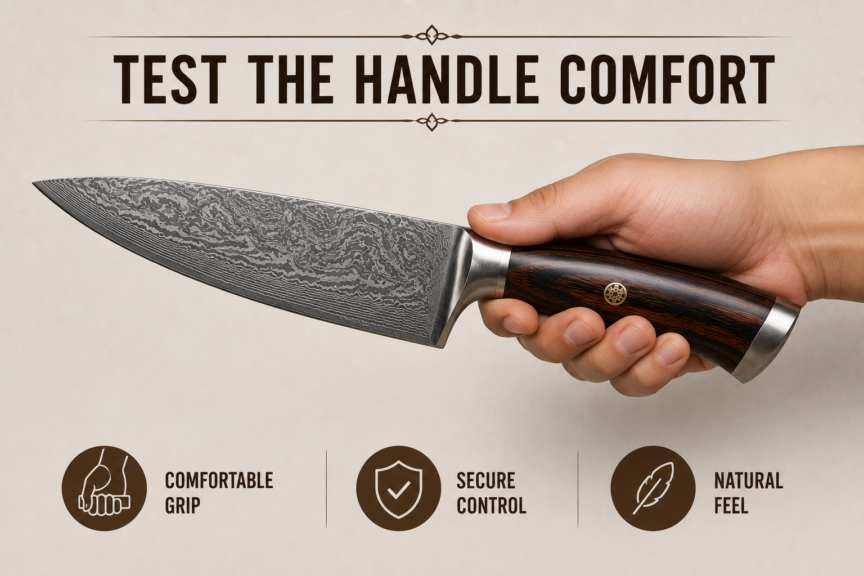
Step 3: Test the Handle Comfort
The handle should feel secure in your hand.
Evaluate:
Grip comfort
Handle shape
Surface texture
Weight
Control during movement
Avoid handles that create pressure points or feel slippery during normal use.
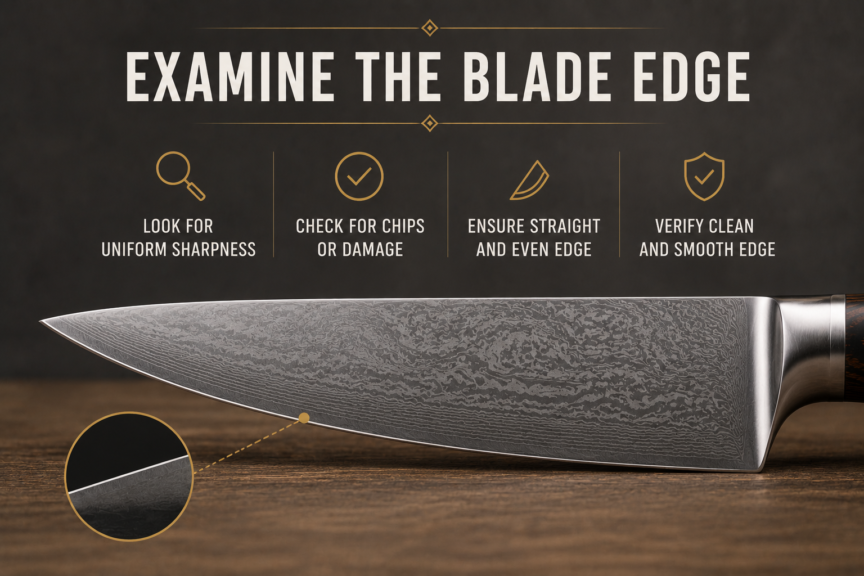
Step 4: Examine the Blade Edge
A quality knife should have a clean, even edge.
Look for:
Uniform sharpening
No chips
No rolled sections
Symmetrical bevels
An uneven edge may affect cutting performance.
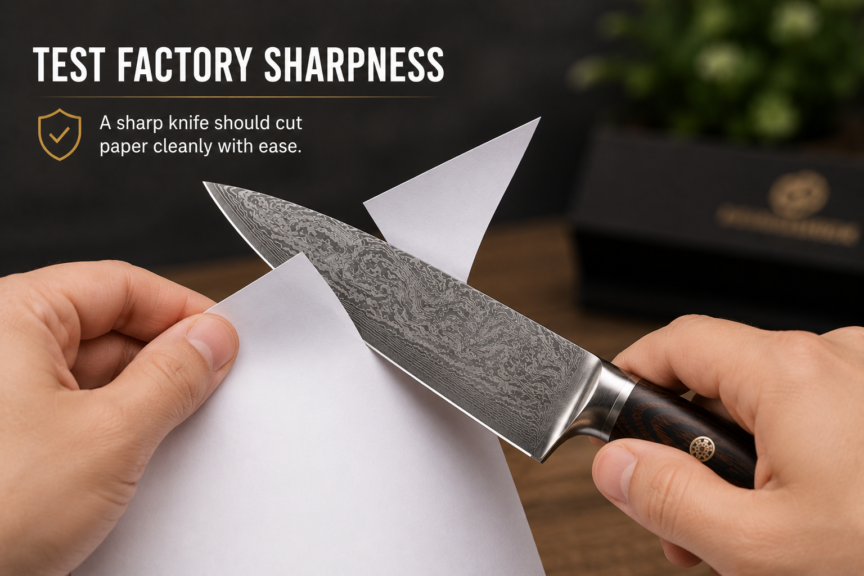
Step 5: Test Factory Sharpness
Several safe materials can help evaluate sharpness.
Common examples include:
Printer paper
Cardboard
Soft vegetables
Fruit
Fresh herbs
A sharp knife should cut smoothly with minimal resistance.
Avoid using materials that could damage the blade during initial testing.
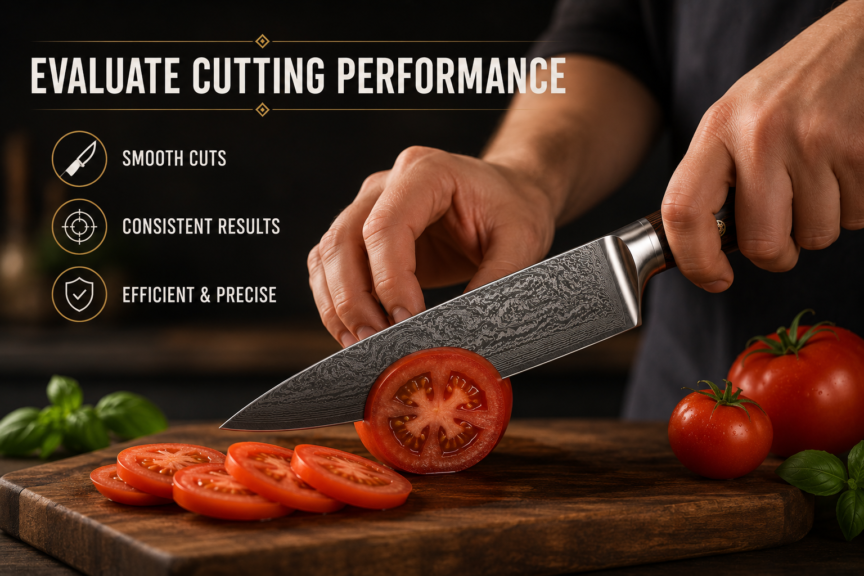
Step 6: Evaluate Cutting Performance
Different knives are designed for different tasks.
Test the knife using materials appropriate for its intended purpose.
Observe:
Cutting efficiency
Control
Comfort
Smoothness
Consistency
The knife should perform naturally without requiring excessive force.
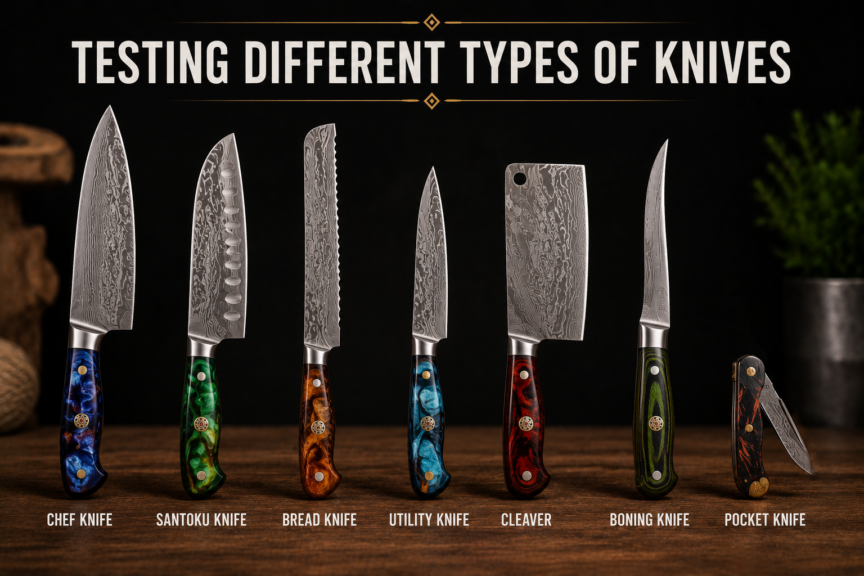
Testing Different Types of Knives
Chef Knife
A chef knife is designed as an all-purpose kitchen tool.
Test it on:
Onions
Tomatoes
Carrots
Herbs
Potatoes
Look for:
Smooth slicing
Easy rocking motion
Comfortable grip
Good balance
Chef Knife
A chef knife is designed as an all-purpose kitchen tool.
Test it on:
Onions
Tomatoes
Carrots
Herbs
Potatoes
Look for:
Smooth slicing
Easy rocking motion
Comfortable grip
Good balance
Santoku Knife
A Santoku knife excels at precise slicing and chopping.
Test using:
Cucumbers
Bell peppers
Boneless meat
Vegetables
Check whether food sticks excessively to the blade and whether cuts remain clean.
Paring Knife
A paring knife should offer excellent precision.
Try:
Peeling apples
Trimming strawberries
Removing seeds
Small detail work
It should feel light, agile, and easy to control.
Bread Knife
Bread knives rely on serrated edges.
Test on:
Fresh bread
Crusty loaves
Cakes
A quality bread knife should slice without crushing the loaf.
Damascus Knife
Damascus knives are appreciated for both appearance and performance.
When testing one:
Inspect:
Pattern consistency
Blade finish
Handle quality
Then evaluate:
Sharpness
Balance
Comfort
Cutting performance
Remember that the visible Damascus pattern does not determine performance on its own. The blade’s core steel, heat treatment, and overall construction are equally important.
Utility Knife
Utility knives bridge the gap between chef and paring knives.
Use them for:
Sandwich ingredients
Cheese
Fruits
Small vegetables
Evaluate versatility and handling.
Check Blade Steel
Different steels offer different advantages.
Some common examples include:
VG-10
AUS-10
440C
14C28N
D2
8Cr13MoV
Compare factors such as:
Edge retention
Corrosion resistance
Ease of sharpening
Toughness
Choose the steel that best fits your intended use and maintenance preferences.
Assess Handle Materials
Popular handle materials include:
Hardwood
G10
Micarta
Resin
Stainless steel
Composite materials
Evaluate:
Grip
Durability
Finish
Comfort
Resistance to moisture
Consider Weight
There is no universally perfect knife weight.
A lighter knife may reduce fatigue during extended use, while a heavier knife may provide more momentum through certain cutting tasks.
The best choice depends on personal preference and intended use.
Test Edge Retention
Edge retention refers to how long a knife remains sharp.
This is difficult to determine during a quick inspection, but you can:
Read reliable reviews
Research the blade steel
Learn about the manufacturer’s heat treatment process
Compare long-term user experiences
Signs of a Quality Knife
A quality knife typically offers:
Comfortable ergonomics
Reliable balance
Consistent grind
Sharp factory edge
Durable materials
Solid construction
Smooth cutting performance
Common Mistakes When Testing Knives
Avoid these mistakes:
Judging a knife only by appearance
Ignoring handle comfort
Assuming heavier always means better
Believing decorative patterns alone indicate quality
Testing on inappropriate materials
Using unsafe cutting techniques
Can I test a knife before buying?
Many specialty knife retailers allow customers to handle display models. Always follow the store’s safety guidelines and ask for assistance if needed.
Does a sharper knife mean better quality?
Not necessarily. Factory sharpness is important, but overall performance also depends on blade steel, heat treatment, geometry, and construction.
Are Damascus knives always superior?
Not always. Some Damascus knives combine excellent craftsmanship with high-performance steel, while others focus mainly on appearance. Evaluate the knife as a whole rather than the pattern alone.
What is the most important test?
Comfort and control are among the most important factors. A knife that fits your hand well is often easier and more enjoyable to use.